Would You Hire Claude?
Last night I had the pleasure of speaking at Nearform’s Futureform event at Mindspace Liverpool Street in London. The event was titled “Agents building systems. Humans orchestrating them.” and I shared the stage with Alfonso Graziano, AI Tech Lead at Nearform and author of “AI-Native Software Engineering”.
My talk was called “Would you hire Claude?” - a deliberately provocative question designed to get people thinking about what it actually means when AI becomes a genuine collaborator rather than just a tool.
The Slides
What Makes a Great Team?
I started by asking the audience what makes a great team. The usual suspects come up: trust, empathy, creativity, autonomy, capability. These are deeply human qualities. But then I asked - what makes those teams effective? The answer is guard rails.
Guard rails like a coherent strategy, written processes, CI/CD, observability, design systems, customer access, and a measurement culture. These are the things that allow talented people to do their best work without stepping on each other.
The Evolution of AI in Engineering
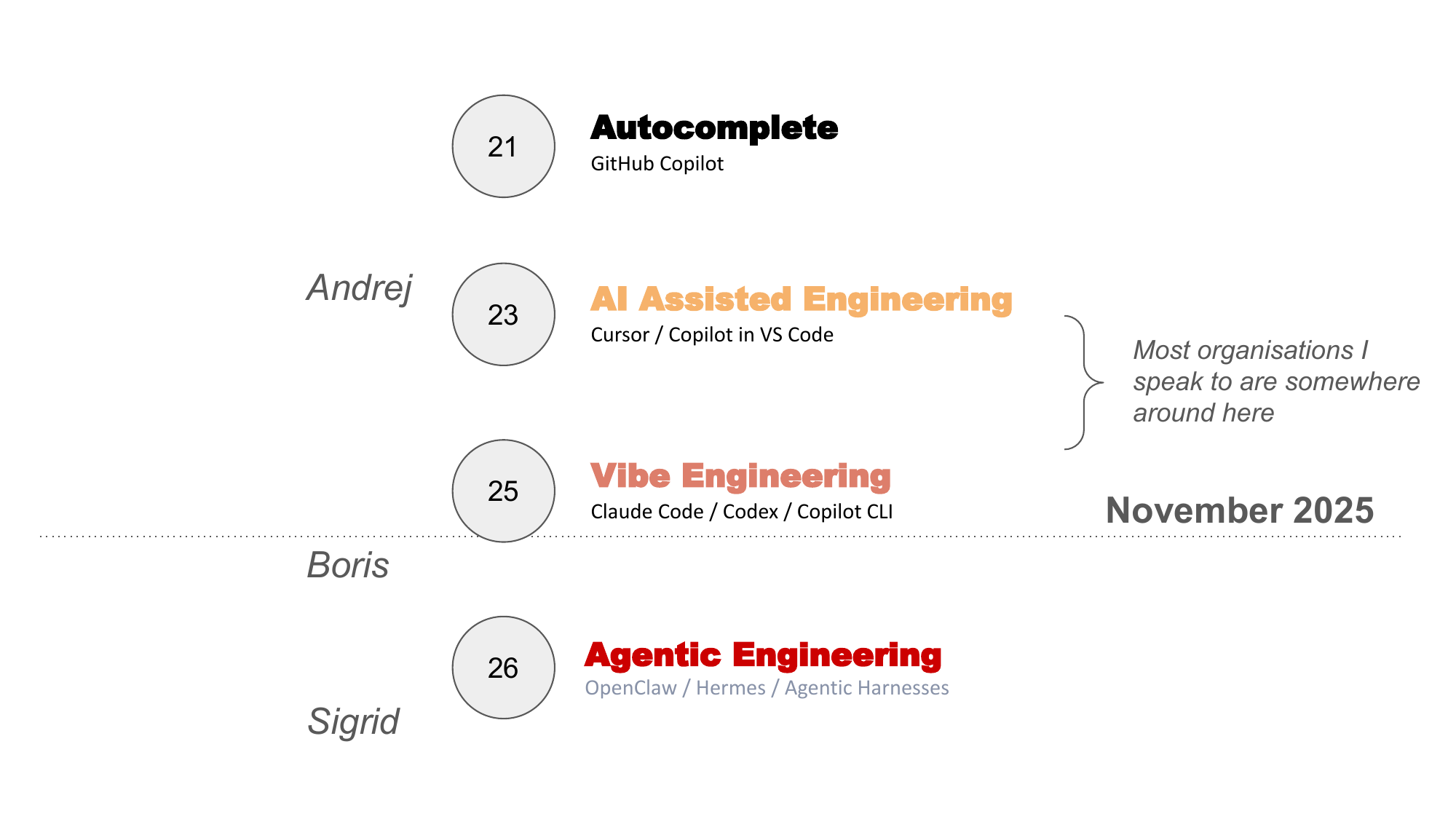
We’ve moved through distinct phases: from autocomplete (GitHub Copilot in 2021), to AI-assisted engineering (Cursor and Copilot in VS Code around 2023), to vibe engineering (Claude Code, Codex, and CLI tools in 2025), and now into agentic engineering (OpenClaw, Hermes, and agentic harnesses in 2026).
Most organisations I speak to are somewhere around the AI-assisted to vibe engineering transition. Many haven’t yet grasped what agentic engineering looks like - where AI agents are building entire systems while humans orchestrate the work.
So What Does It Mean for Us Humans?
This was the heart of the talk. I broke it down into three levels: individuals, teams, and organisations.
Individuals
We need to develop new skills and accept that some of our hard-earned skills are less valuable. The role is shifting from coder to orchestrator and context manager. We need to let go of strongly held beliefs and embrace specification and verification as core disciplines.
Problem definition, system thinking, architecture, harness design - we move upward away from the specifics of implementation. And for those feeling anxious about it: you are not behind, take a deep breath, you have time.
Teams
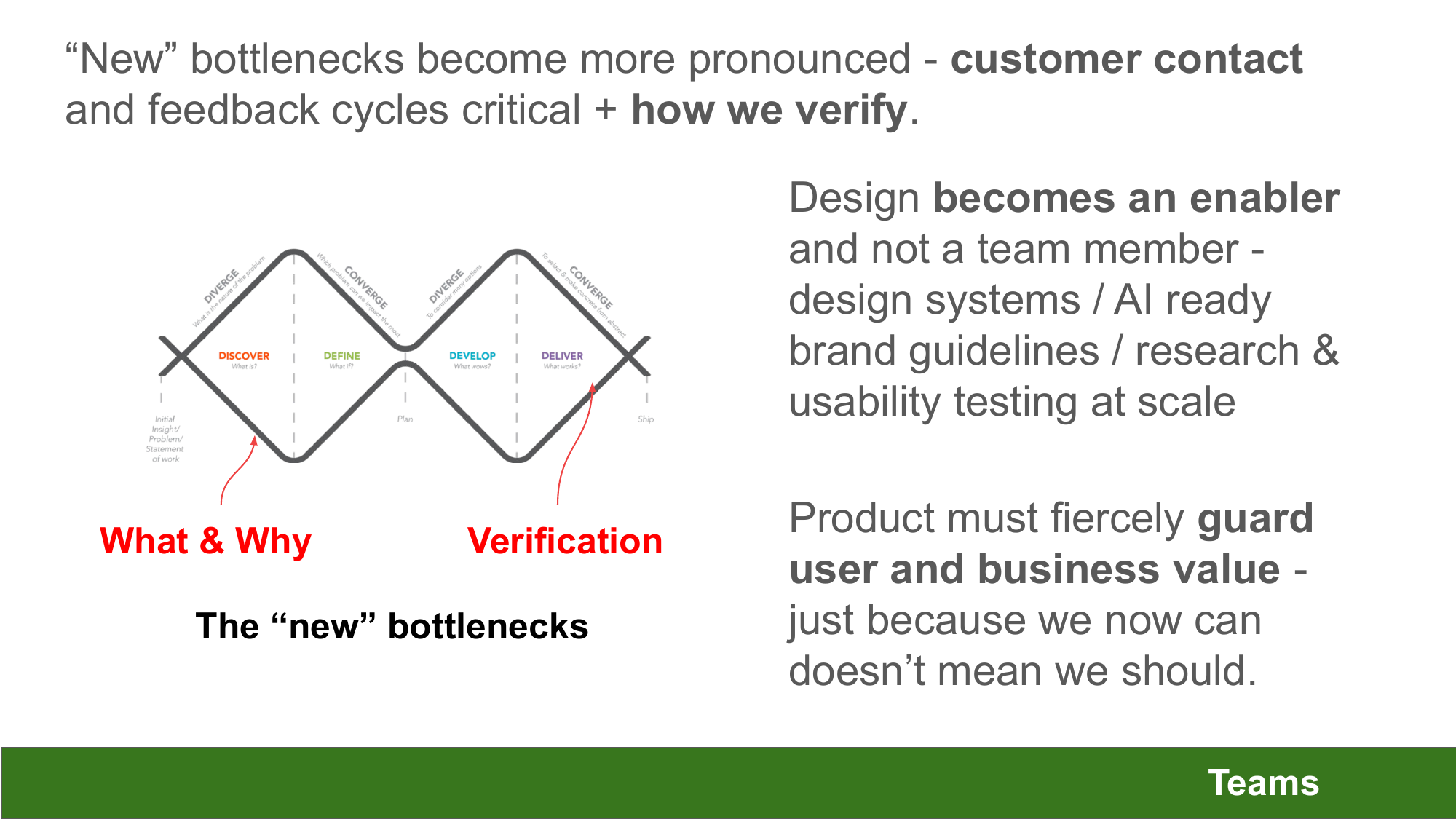
The “new” bottlenecks become more pronounced. Customer contact and feedback cycles become critical, along with how we verify what’s being built. Design becomes an enabler rather than a team member - think design systems, AI-ready brand guidelines, research and usability testing at scale.
Product must fiercely guard user and business value. Just because we can build something now doesn’t mean we should.
Team topologies evolve towards “Value Pairs”, product engineers, and forward-deployed engineers. We end up with more, smaller teams and hybrid roles focused on problem solving rather than code writing.
Organisations
The guard rails that you may have been struggling to make a case for become must-haves in an agentic world: design systems, data platforms, CI/CD, observability, and developer experience.
How you look at investment and financials needs to evolve too. Outcome over output, token budgets alongside personnel budgets. But procurement, finance, and your partners are most likely not ready for this shift yet.
The operating model must evolve, especially how fast-moving, outcome-oriented teams connect directly to customers and access data. There will be an evolution in roles and how you hire, develop, and retain talented people.
Final Advice
I closed with three pieces of advice:
- Try to build something you previously thought was impossible. The tools are there - use them.
- Create space and time to explore. Try lighthouse teams. Do it in a safe way.
- You are not behind. You have time.
Projects I Mentioned
During the talk I showed a few of my open source projects that demonstrate what’s possible with these tools:
- Drizzle Cube - an embeddable semantic layer for analytics
- Drizby - an open source BI platform
- Last Light - agentic engineering tools
If any of these are interesting to you, I’d really appreciate a follow, star, or contribution.
Thanks to Nearform for hosting and to everyone who came along. If you were there and want to continue the conversation, find me on LinkedIn or check out more on guidemode.dev.